
Planning for Post Event Recovery – In Advance
Even if their impact is lessened by mitigation efforts, disasters are going to happen. Planning for post event recovery – defined here as going beyond the restoration of infrastructure function to include the restoration of economic and social activity – becomes a critical part of adaptation to this reality.
However, in many years of working with cities and businesses on disaster risk reduction (DRR) issues, I have become aware of a curious difference between the private and public sectors. When a well-run business undertakes business continuity planning (BCP), it plans right “through” the disaster to resuming production and serving customers. Making money by producing things and serving customers is the raison d’etre for the business, and it seems that recovering to that point is automatically assumed to be the task at hand.
With exceptions, towns and cities don’t do this to the same degree. They may plan and act to mitigate the impact of disastrous events, often very effectively; they plan for the short-term aftermath (debris removal, maintaining law and order, re-starting water supplies and sanitation and so on); and they may plan for longer term rebuilding, perhaps following FEMA’s National Disaster Recovery Framework:
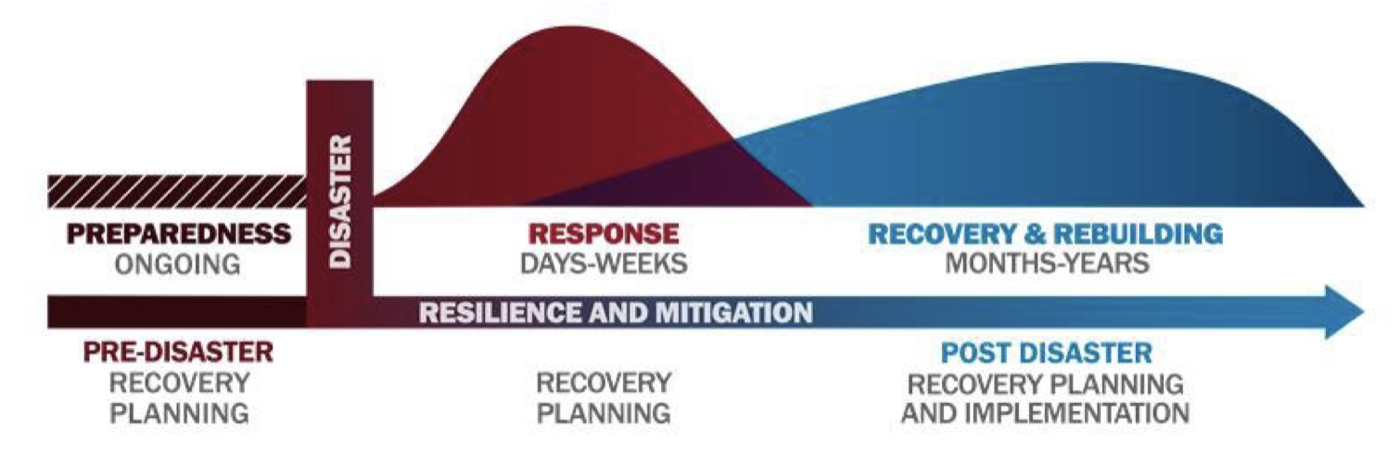
However, relatively few towns and cities pursue this to fully embrace what can be done to expedite the resumption of economic and social activity. This omission is a major factor in recovery often taking much longer than the community can withstand. Smaller businesses may go out of existence due to lack of cashflow, employment and community facilities may be lost, and people may move away, maybe never to return. As a result, the town or city may remain economically and socially stunted for many years. To help avoid this, towns and cities need their own counterpart to business continuity planning that addresses the longer-term aftermath of a disaster. Let’s call it community continuity planning (CCP).
What would CCP consist of? Here are some components that may form part of a complete community continuity plan.
1. Anticipate physical post-event needs and lock in suppliers
In the aftermath of a disaster, it is possible to anticipate many needs – warehousing, trucks, bulldozers, accommodation for people and pets, generators, ground remediation, infrastructure repairs, and so on. Many Japanese cities, and now some in the US, are starting to create inventories of which businesses can supply these and other items in the event that a disaster is declared. In a few cases, contingency contracts are being let for these items. This should be more widespread, ideally with prices negotiated (annually, if necessary) so that the city does not get gouged in the usual post-disaster fashion. If the short-term recovery is expedited, longer term recovery can begin sooner.
Another need is to try to anticipate where road transport systems are most at risk of disruption in the event of a disaster and preposition emergency supplies (food/water, medical supplies, tarpaulins, perhaps heavy equipment) accordingly, so that they do not become trapped the wrong side of an earthquake-damaged bridge or a washed-out road. Some towns now invite food pantry users to come in before a weather event is anticipated to pick up a box of supplies for the days after the event.
A third key need to anticipate is enabling those seeking to repair or rebuild homes to expedite that work. This may mean, as examples, policies for balancing the relaxation of building codes to enable faster rebuilding with the risk of perpetuating existing vulnerabilities; mutual aid agreements with neighboring cities to ensure enough building inspectors; and negotiating discounts with suppliers of building materials. Going further, to help overcome housing shortages, some cities now have pre-approved housing designs that can be permitted rapidly: perhaps this strategy could be deployed to enable rapid replacement of lost housing stocks after a disaster.
2. Widen and deepen the definition of critical assets
Typically, critical assets are defined as those that form part of major infrastructure systems. But if the goal of recovery is to restore the social and economic functioning of the town or city, then assets that are “critical” to this objective should also be included. They might include employment and retail foci (especially food and hardware stores, large shopping malls), market and meeting places perhaps including churches, and hospital outpatient facilities. In smaller and more remote communities, the definition of “critical” would extend down to the local corner store, ATM and gas station. Prolonged loss of any of these is likely to impose major time and/or monetary costs on their users and make the community less “livable”. As a result people may leave, often never to return. Investing in hardening these assets may therefore be important for long term recovery, even if they are owned by third parties.
At the same time, the city will need to know how its critical assets are interlinked, so that the risk of an upstream failure to, say, the electricity supply or a road bridge does not undermine the investment in the asset in question. This is what deepening the definition of critical assets means: it is not enough just to know that an asset is there, but instead the city needs to know how its critical assets are connected one with another, so that risks of cascading failures can be spotted in advance and investment directed to their mitigation.
3. Encourage businesses to create continuity plans
The first duty of a business in a disaster is to survive, so that employment, economic vitality and tax income are protected for the benefit of the community as a whole. Yet huge numbers of businesses go out of existence after a disaster – especially small medium enterprises (SMEs), of which FEMA estimates that 40% fail to survive and many more fail within the following year. This creates a major economic void that some communities never succeed in filling. And yet many SMEs – and even some larger businesses – do not have BCPs. Towns and cities therefore need to do everything in their power to encourage businesses to create BCPs, whether through publicity, procurement policies and taxation incentives that favor those with plans, subsidies for the cost of creating them, making BCPs an aspect of code compliance, planning agreements or other means. This would especially be the case if the business owns or operates a critical community asset; and by the same token, it needs to apply to the town/city government itself.
4. Investigate group and parametric insurance
Many homeowners and businesses do not have (or cannot obtain) adequate insurance. A disaster thereby becomes financially more crippling than it needs to. Some insurance companies now offer community-based catastrophe insurance, intended to be purchased by local governments to cover multiple buildings, businesses and assets in their area, or alternatively, to cover disaster-related expenses such as emergency accommodation. More towns and cities need to investigate this option as an investment in their continued existence.
In addition, the insurance loss adjustment process after a disaster can take many months to complete and is frequently highly contentious. This becomes a major factor in businesses going out of existence and forcing people to leave the area. Parametric insurance, which automatically pays out after objectively verifiable criteria are met (for example, “six inches of rain at location x in a 12-hour period”) has no loss adjustment process. While payouts may not be as high, they are much faster. This can make the difference between a business going out of existence or not, or a homeowner being enabled to rapidly repair their home, or not.
5. Create an economic recovery plan
This should address pre-event measures such as those above. It should set out a recovery governance structure, including the roles of different stakeholders (city departments, chambers of commerce, employers and outside agencies). It should have potential sources of finance researched and validated. And it should set out phased recovery goals and metrics, such that people know what to expect and by when. It should explicitly dovetail short term relief with longer term economic assistance and re-building.
Post event recovery is routinely one of the least well-considered aspects of DRR. No matter how thorough a town or city’s pre-event mitigation may be, a disaster could still happen. Adaptation to that possibility therefore becomes essential, and the strategies above should be part of that effort.